



























UK Economy: Growth Beats Forecasts, Risks Remain
UK GDP growth topped expectations and business investment rose, but inflation, unemployment and fiscal pressures leave the economic outlook deeply divided.


UK Economy Sends Mixed Signals as Growth Beats Forecasts but Storm Clouds Gather
Is the British economy thriving or merely limping along? Depending on which set of figures you look at, either answer seems defensible right now, and economists are increasingly split over how to read a picture that refuses to resolve neatly in either direction.
The Case for Optimism
On the encouraging side of the ledger, the Office for National Statistics reported that growth in June came in at 0.3%, ahead of what most forecasters had pencilled in. Business investment — long considered one of the UK economy's weakest links — rose by 1.7% over the same period, a notable improvement after years of hesitancy from firms wary of committing capital amid political and economic uncertainty.
The FTSE 100 has also had a strong run, registering gains across six consecutive quarters and trading near record territory in recent sessions. Consumer confidence, as measured by the closely watched GfK survey, climbed to a two-year high this month, suggesting households are feeling somewhat steadier despite the well-documented pressures on living costs. Separate purchasing managers' data pointed to firms and shoppers alike opening their wallets more freely than in recent months, a signal some economists interpreted as evidence that the economy is genuinely picking up pace rather than merely treading water.
The Case for Caution
Set against that, the picture darkens quickly. The latest labour market figures show unemployment holding at 4.9%, a touch higher than the same period last year, while job vacancies have fallen and youth unemployment remains stubbornly elevated, with roughly one in six people aged 16 to 24 out of work. The number of UK firms classified as being in financial distress has risen by around 9%, driven largely by consumer-facing sectors still grappling with squeezed margins and cautious spending.
Government finances have also thrown up unwelcome surprises. A wider-than-expected budget deficit landed alongside a surprise drop in retail sales, complicating the fiscal picture for the Treasury just as it navigates the aftermath of a difficult first budget under Chancellor Rachel Reeves. Analysts have noted that the combination of a weaker deficit position and softer consumer spending gives policymakers less room to manoeuvre than they might like.
Inflation Still the Wildcard
Perhaps the most consequential variable remains inflation. Core CPI, which strips out volatile items such as energy and food, fell to 2.6% in the year to June — its lowest level since March last year — offering some reassurance that price pressures are easing. However, several forecasters expect inflation to tick back upward in the second half of the year, with some projections putting the UK among the hardest-hit major economies as global energy costs remain elevated following disruption linked to conflict in the Middle East.
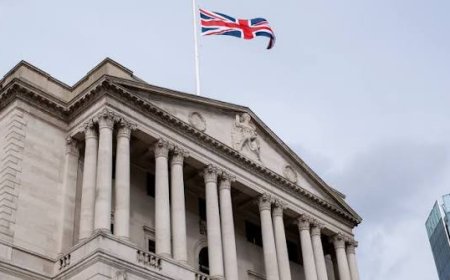
The Bank of England has held its base rate steady in recent months, pausing a cutting cycle that had previously brought borrowing costs down substantially from their post-pandemic peak. Governor Andrew Bailey has been candid about the difficulty of the Bank's task, describing the decisions ahead as involving "difficult judgements" given the conflicting signals in the data. Markets are now pricing in at least the possibility that rates could rise again before the year is out, a scenario few would have predicted with confidence just months ago.
The AI Productivity Question
Adding a further layer of complexity, some economists point to artificial intelligence adoption as a quiet but meaningful factor behind recent productivity gains — even as questions persist about the costs, both economic and social, of that transition. Business investment tied to AI infrastructure and automation has been cited as one contributor to the uptick in capital spending, though the longer-term implications for the labour market remain hotly debated.
What It Means for Households and Businesses
For ordinary households, the net effect of these competing trends is likely to feel less like a recovery and more like a plateau — modest wage growth, in real terms, alongside continued caution about big-ticket spending. Average wages excluding bonuses have risen by 3.4% over the past year, only slightly ahead of inflation, meaning many families are seeing only marginal improvement in their financial position.
For businesses, the message from recent data is similarly ambiguous: enough underlying resilience to justify continued investment, but not enough certainty to abandon the caution that has characterised boardroom decision-making since the shocks of recent years. With a full year still to run under the current government's economic strategy, much will depend on whether growth in the second half of 2026 can build on June's encouraging figures or whether the drag from unemployment, distress in consumer sectors and fiscal constraints proves the more powerful force.
Next Article
What's Your Reaction?
 Like
0
Like
0
 Dislike
0
Dislike
0
 Love
0
Love
0
 Funny
0
Funny
0
 Angry
0
Angry
0
 Sad
0
Sad
0
 Wow
0
Wow
0