




























Air Taxis to Cut NCR Travel: Gurugram to Noida Airport in 30 Minutes
A CII report proposes eVTOL air taxis for Delhi-NCR, slashing travel times. Gurugram to Noida Airport could take just 30 minutes, transforming urban mobility.

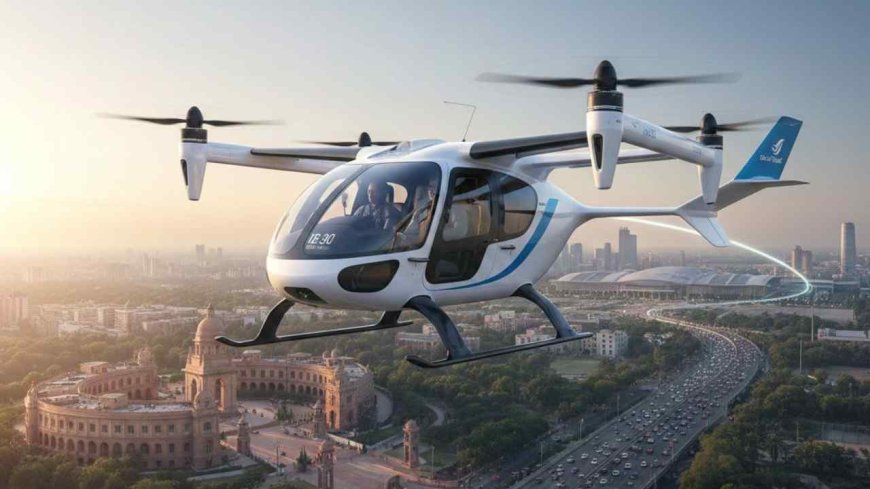
Air Taxis Could Shrink NCR Travel Times — Gurugram to Noida Airport in Just 30 Minutes
A new report by the Confederation of Indian Industry (CII) proposes a revolutionary solution for Delhi-NCR's notorious traffic: air taxi services. Using electric vertical take-off and landing (eVTOL) aircraft, commutes between major hubs like Gurugram and the upcoming Noida International Airport (Jewar) could be reduced to under 30 minutes, bypassing hours of road congestion.
Why Air Taxis Are Being Considered for NCR
Traffic gridlock in the National Capital Region has made long-distance travel unsustainable. A road trip from central Delhi to Jewar Airport can exceed 2-3 hours. The CII's Advanced Air Mobility (AAM) vision utilizes direct aerial corridors, covering the 65-75 km straight-line distance in roughly 18-20 minutes of flight time.
This isn't science fiction. eVTOL technology is advancing globally, offering a viable alternative to decongest roads and reclaim productive time for millions.
Proposed Air Taxi Routes and How They'd Work
Delhi's complex airspace, with restrictions around IGI Airport and defense zones, requires smart routing. The CII study outlines feasible corridors:
-
Gurugram to Connaught Place: ~35-38 km in 12 minutes, routing north to avoid restricted zones.
-
Central Delhi to Jewar Airport: ~65-75 km in 18-20 minutes, skirting urban congestion.
Vertiports (dedicated take-off/landing hubs) would be established on building rooftops or existing helipads, minimizing land acquisition costs and accelerating deployment.
Phased Rollout and Key Benefits
Adoption would be phased, beginning with critical services:
-
Medical Emergency Transport: For rapid organ delivery and patient transfers.
-
Cargo Logistics: Time-sensitive deliveries.
-
Tourism & VIP Travel: Niche premium services.
This approach builds operational experience and public trust before scaling to mass passenger transit. Key advantages include:
-
Time Savings: Slashing multi-hour commutes to minutes.
-
Reduced Congestion: Alleviating pressure on overburdened road networks.
-
Sustainability: Zero tailpipe emissions from electric aircraft, especially with renewable energy charging.
-
Cost-Efficiency: Rooftop vertiports can reduce infrastructure costs by 30-50%.
Regulatory Framework and Safety
A robust regulatory ecosystem is crucial for safe integration. Responsibilities would be shared:
-
Ministry of Civil Aviation: Overall urban air mobility policy.
-
Directorate General of Civil Aviation (DGCA): Aircraft certification, vertiport safety standards, and pilot licensing.
-
Airports Authority of India (AAI): Air traffic management integration.
Clear regulations are essential for public safety, traffic deconfliction, and fostering investor confidence in this nascent industry.
The Future of Urban Mobility in India
Successful implementation in Delhi-NCR could serve as a blueprint for other Indian megacities like Mumbai, Bengaluru, and Hyderabad, all plagued by similar congestion.
Beyond mere convenience, urban air mobility represents a paradigm shift—redefining city planning, reducing carbon footprints, and enhancing economic productivity through unprecedented connectivity.
Conclusion: A Transformative Vision
The CII's air taxi proposal offers a tangible glimpse into a less congested future for NCR. While challenges around regulation, cost, and public acceptance remain, the potential to transform a 3-hour grind into a 30-minute glide presents a compelling case for innovation. As technology and policy converge, soaring over traffic may soon become an everyday reality for India's urban dwellers.
What's Your Reaction?
 Like
0
Like
0
 Dislike
0
Dislike
0
 Love
0
Love
0
 Funny
0
Funny
0
 Angry
0
Angry
0
 Sad
0
Sad
0
 Wow
0
Wow
0